
Get Fresh Cocktail Recipes in Your Inbox
Join our newsletter and receive exclusive cocktail recipes, tips & mixology secrets every week.
No spam, just good taste. Unsubscribe anytime.
 ByJames
Layered cocktails look impressive behind the bar, but the technique is simpler than you think. It’s not about magic or years of bartending experience. Understanding one basic principle and using the right pouring method will get you clean, distinct layers every single time.
The secret to layering is density. Some liquids are heavier than others, and when you pour them carefully, they stack instead of mixing.
What makes a liquid heavy? Sugar. What makes it light? Alcohol. A bottle of grenadine syrup is loaded with sugar and zero alcohol, so it sinks straight to the bottom. Vodka is the opposite: high alcohol, minimal sugar, so it floats on top of almost everything.
This gives you a natural hierarchy. Syrups and liqueurs with lots of sugar sit at the bottom. Fruit liqueurs and cream liqueurs occupy the middle. Spirits like vodka, rum, or tequila float on top.
Pour heavy first, light last. That’s the entire foundation.
You don’t need a chemistry degree. Just check two numbers on any bottle.
Sugar content is sometimes listed in grams per serving. More sugar means heavier liquid. If the label says “liqueur” or “cream,” expect it to be dense.
ABV (alcohol by volume) tells you how much pure alcohol is inside. Higher ABV usually means lighter, especially if sugar content is low.
Quick mental shortcut: if it’s thick, sweet, and syrupy, it goes early. If it’s clear, strong, and boozy, it goes late.
You don’t need a full bar setup. Just a few basics.
A bar spoon is the key tool. The long handle lets you pour liquid down its length, which slows the flow and spreads it gently across the surface below. If you don’t have one, a regular teaspoon works, but the short handle makes control harder.
A shot glass or jigger keeps your measurements consistent. Precision matters when you’re stacking multiple ingredients in a small space.
Use a straight-sided glass like a highball, rocks glass, or shot glass. Curved glasses hide the layers. Straight walls show off the stripes.
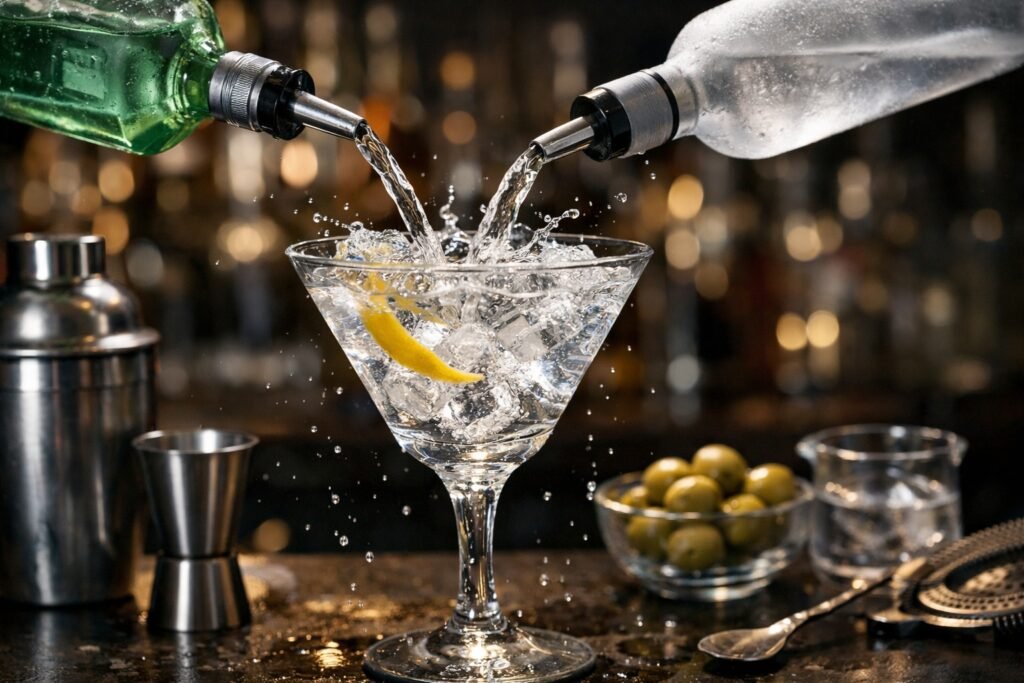
Optional but helpful: bottle pourers. They regulate the flow when you’re pouring from a full bottle, which can otherwise gush out too fast.
Here’s where theory becomes practice.
Take your densest ingredient and pour it straight into the glass. No technique required yet. Just fill it to whatever level you want, usually around a third of the glass for a layered shot, or half an ounce to an ounce for cocktails.
This layer is your foundation. Everything else builds on top.
Turn your bar spoon upside down. The round back of the spoon should face up.
Place the tip of the spoon against the inside edge of your glass, just above the surface of your first layer. The spoon shouldn’t touch the liquid. Leave a tiny gap, maybe a quarter inch.
Hold the spoon steady with one hand. This is your pouring platform.
Tilt your bottle slightly and pour the next ingredient slowly down the handle of the spoon. The liquid should run along the spiral, hit the back of the spoon, and spread gently across the surface of the first layer.
Slow means slow. Start with a trickle, almost drop by drop. You can speed up slightly once you see the layer forming, but rushing here destroys everything.
As the liquid level rises, lift the spoon gradually to keep it just above the surface. You’re always hovering, never submerged.
Same process for the third, fourth, or fifth layer. Each time, you’re pouring over the spoon, letting the new liquid glide onto the one below.
The more layers you add, the trickier it gets. There’s less room for error, and the liquid column is taller, which means more pressure. Go even slower on upper layers.
Everyone messes up the first few times. Here’s what usually goes wrong.
If you pour too quickly, the force pushes through the lower layer and everything mixes into a cloudy mess.
Solution: Use a half-empty bottle if possible. A full bottle is harder to control because the liquid rushes out under its own weight. Transfer some into a smaller container or just wait until you’ve used half the bottle naturally.
If your spoon dips into the liquid below, it breaks the surface tension and causes the layers to blend.
Keep the spoon elevated. It should float just above, not rest on the liquid. This takes a steady hand, but you’ll get the feel after a couple tries.
If you accidentally pour a light liquid before a heavy one, it won’t layer. The heavy liquid will crash through and sink, mixing both.
There’s no fix mid-drink. You either start over or stir it together and serve it as a regular mixed drink. Check your ingredients’ densities before you start pouring.
Room temperature liquids behave unpredictably. Heat makes liquids expand slightly, which changes their density just enough to mess with your layers.
Chill everything beforehand. Keep your bottles in the fridge or freezer for at least 30 minutes before layering. Cold liquids are denser and more stable.
Start with ingredients that have obvious density differences. The wider the gap, the more forgiving the technique.
Easy level: Grenadine, orange juice, vodka. Grenadine is syrup-heavy and sinks immediately. Orange juice sits in the middle. Vodka floats on top. Hard to mess up.
Medium level: Kahlúa, Baileys Irish Cream, Grand Marnier. This is the classic B52 shot. The densities are closer, so your technique matters more, but it’s still a proven combination.
Advanced level: Try layering two fruit liqueurs with similar sugar content, like blue curaçao and melon liqueur. These require perfect pouring because the density gap is narrow.
Stick to established recipes at first. Once you can layer a B52 without thinking, then experiment with custom combinations.
Small adjustments make a big difference.
Chill your glass before you start. A cold glass keeps the first layer stable while you build on top.
Use fresh, full bottles when possible. Bottles that have been opened and closed repeatedly have more air inside, which can cause uneven pouring.
Don’t shake the bottles before layering. Shaking mixes air into the liquid, which changes its density temporarily.
Work quickly once you start. Liquids naturally want to mix over time, especially if there’s any temperature difference. Layer your drink and serve it within a minute or two.
If your layers blur slightly at the edges, wait 10 to 15 seconds. Sometimes they’ll separate on their own as the liquids settle.
Some combinations refuse to layer no matter how careful you are.
If two liquids have nearly identical densities, they’ll blend instead of stack. You can’t fight physics. Either swap one ingredient for something with a clearer density difference, or accept that this particular drink won’t layer.
Temperature and brand matter. A cold Baileys might layer differently than a room-temp one. One brand of coffee liqueur might be slightly heavier than another. Small variables add up.
If your layers fail, the drink still tastes exactly the same. Just stir it, pour it over ice, and call it a mixed cocktail instead. Nobody will complain.
Expect to practice. Your first attempt might look muddy. Your third will probably look decent. By your fifth, you’ll have the rhythm down and won’t even need to think about it.
Layering is one of those techniques that clicks suddenly. You’ll go from struggling to smooth in the span of a single practice session, and then it’s yours forever.