
Get Fresh Cocktail Recipes in Your Inbox
Join our newsletter and receive exclusive cocktail recipes, tips & mixology secrets every week.
No spam, just good taste. Unsubscribe anytime.
 ByJames
Yes, you can absolutely use a mason jar as a cocktail shaker, and it works better than you’d think. The threaded lid creates a solid seal, the glass handles cold just like a proper shaker, and the larger volume actually gives you room to batch multiple drinks at once. The technique is simple, the results are clean, and you probably already own one.
A cocktail shaker only needs two things to work: a watertight seal and enough room to agitate liquid with ice. Mason jars deliver both. The two-piece lid system (flat disk plus screw band) creates an airtight seal when properly tightened, just like the friction fit between Boston shaker tins.
That seal does real work. It keeps liquid inside while you shake hard enough to properly aerate the drink and break down ice for dilution. Without it, you’re just making a mess.
The trick is screwing the band on firmly, but not so tight you’ll need pliers to open it afterward. Snug pressure with your dominant hand is enough.
Glass transfers temperature efficiently. When you shake a cocktail in a mason jar, the cold moves through the glass to your hands within seconds. That’s your cue the drink is getting properly chilled.
Metal shakers (especially stainless steel) do this too, sometimes faster. But glass gets cold enough, fast enough, to do the job right. You’ll feel frost forming on the outside after 10 seconds of shaking, exactly like a tin shaker.
One bonus: glass doesn’t impart any metallic taste. Some people notice a faint metallic note from cheaper stainless shakers, especially with citrus-heavy drinks. Not an issue here.
Start with your mason jar at room temperature. Add your cocktail ingredients first, then fill the jar about two-thirds full with ice. Not more. You need empty space at the top for the liquid and ice to move around during shaking.
Screw on both parts of the lid: the flat disk sits directly on the jar opening, then the screw band holds it in place. Tighten firmly with one hand.
Grip the jar with both hands. One hand on the bottom, one hand on top covering the lid. This distributes pressure and keeps the lid secure even during aggressive shaking.
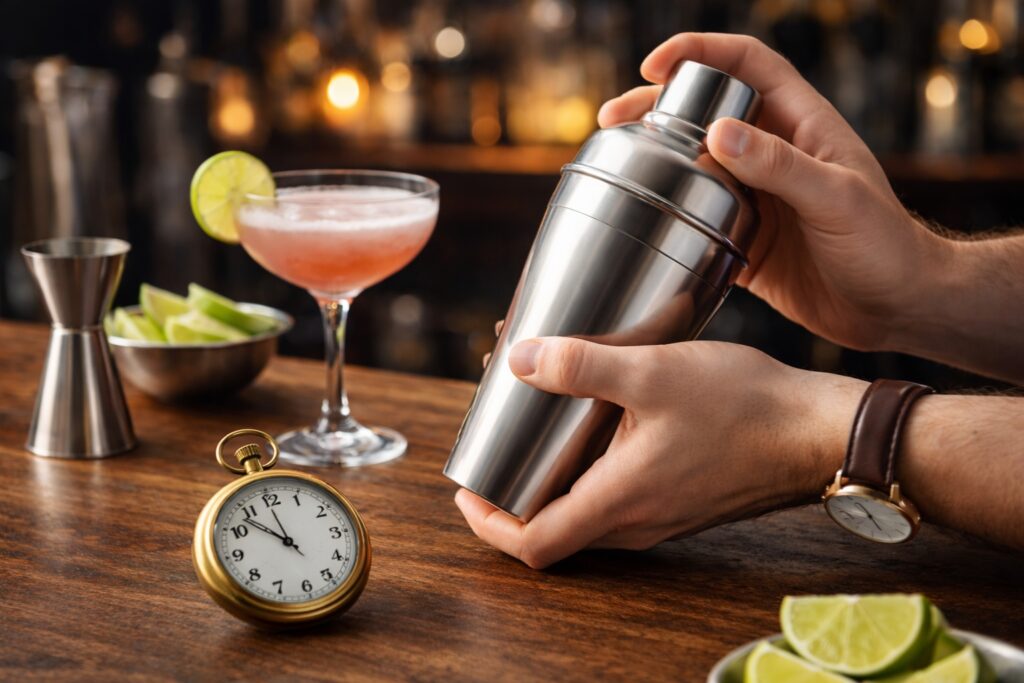
Shake hard for 10 to 15 seconds. You want vigorous, rhythmic movement. Listen for the sound to change as the ice breaks down and the drink aerates. That crackling, slushy sound means you’re diluting and chilling properly.
When the outside of the jar frosts over and feels painfully cold in your hands, you’re done.
Standard mason jar lids don’t have built-in strainers. This is the one real functional gap between a jar and a proper cocktail shaker.
You have three practical options.
Option one: Remove the screw band and offset the flat lid slightly. Tilt it so there’s a small gap on one side. Pour slowly, letting liquid flow through the gap while ice stays trapped inside. This works for most drinks but takes a little practice to avoid spilling.
Option two: Use a small mesh strainer. Hold it over your glass and pour the entire contents of the jar through it. This catches ice and any small bits (citrus pulp, muddled herbs). It’s the cleanest method and works perfectly for fine straining.
Option three: Buy a cocktail shaker lid designed for mason jars. These screw on like a normal lid but have an integrated strainer. They cost $10 to $20 and add convenience if you shake drinks regularly. Not essential, but nice to have.
For muddled cocktails (mojitos, mint juleps) or anything with egg white, always use option two or three. Tiny herb fragments and foam need finer straining than the offset lid method provides.
A quart mason jar holds 32 ounces. Most standard cocktail shakers max out around 28 ounces, and many home models are even smaller. That extra volume lets you batch three or four drinks in one shake instead of working in rounds.
This matters when you’re mixing for a group. One shake, one strain, four margaritas ready to pour. You save time and keep drinks consistent.
Glass also gives you visibility. You can see if sugar has dissolved, if muddled ingredients are properly broken down, if egg white is emulsifying. With opaque metal shakers, you’re shaking blind.
Mason jars don’t dent. Cheap metal shakers warp and dent if you drop them or shake too aggressively against a hard surface. A dented shaker loses its seal and becomes useless. Glass either survives or breaks, no slow degradation.
And finally, the jar does triple duty: shaker, storage container, and serving glass. Make a batch of cocktails, stick the jar in the fridge with the lid on, pour when ready. Or serve directly from the jar for casual settings.
Mason jars are sturdy, but they’re still glass. Drop one on tile or concrete and it shatters. Shake too hard against a countertop edge and you risk cracking it.
Thermal shock is the bigger risk. Never put a mason jar directly from the freezer into hot water, or vice versa. Extreme temperature changes can cause the glass to crack. This mostly matters if you’re pre-chilling your jar in the freezer (unnecessary, by the way) or if you shake something hot.
Shake over a folded towel or soft surface until you get comfortable with the motion and grip. This cushions any accidental impacts.
A Hawthorne strainer (the coiled spring strainer used with Boston shakers) clicks into place and strains as you pour. It’s fast and one-handed.
With a mason jar, you need to offset the lid, hold a separate strainer, or screw on a specialty lid. It’s an extra step. Not a dealbreaker, just slower.
For fine straining (double straining through a mesh strainer to remove all solids), you need a second tool either way. So this drawback mostly applies to basic straining.
Metal conducts cold fast. After 10 seconds of shaking, that metal lid feels like touching ice. Your hand will ache if you grip it directly.
Solution: wrap a bar towel or dish towel around the lid before shaking. Or wear a thin glove. Or just accept numb fingers for 15 seconds. You adapt quickly.
The bottom of the jar gets cold too, but glass conducts slower than metal, so it’s more tolerable.
Pint jars (16 ounces) work for a single cocktail. They’re compact, easy to handle, and give you enough room for ice and liquid without overfilling. Good for personal use or if you’re only making one drink at a time.
Quart jars (32 ounces) are ideal for batching. You can shake two to four servings depending on the recipe. This is the sweet spot for entertaining or making drinks for a small group. The larger size is still manageable to shake, and the extra capacity pays off.
Half-pint jars (8 ounces) are too small. You’ll barely fit ice and liquid for one drink, and there’s no room for proper agitation. Skip these.
Wide-mouth jars vs. regular-mouth: regular-mouth jars pour more precisely. The narrower opening gives you better control when straining and pouring into a glass. Wide-mouth jars are easier to fill and clean, but the pour is sloppier.
No. The standard two-piece mason jar lid works fine for shaking cocktails.
Specialty cocktail shaker lids exist, and they cost between $10 and $20. They screw onto regular or wide-mouth mason jars and add features like a built-in strainer, a removable cap that doubles as a jigger, or a pour spout.
These are convenient, not essential. You’re paying for faster straining and slightly cleaner workflow. If you shake drinks in a mason jar once a month, save your money. If you do it weekly, the convenience might be worth it.
The quality varies. Look for stainless steel construction and good user reviews about the seal. Cheap versions leak or don’t strain well, which defeats the purpose.
Any shaken cocktail works beautifully. Margaritas, daiquiris, whiskey sours, cosmopolitans, sidecars. These drinks need aggressive shaking for proper dilution and aeration, and a mason jar handles that perfectly.
Egg white cocktails actually benefit from the extra headspace in a quart jar. Drinks like whiskey sours with egg white, pisco sours, or Ramos gin fizzes need room for the egg white to emulsify and foam. The larger volume helps.
Batch cocktails for small gatherings are where mason jars shine. Shake four servings of a margarita or mojito at once, strain into individual glasses, done. Much faster than shaking in rounds.
Avoid stirred drinks like martinis, Manhattans, or Negronis. These cocktails require gentle stirring to chill and dilute without aerating. Shaking them creates unwanted bubbles and cloudiness. Use a mixing glass for these, not a jar.
Also skip layered drinks or anything requiring precision pouring. The jar works for shaking and straining, not for delicate bartending techniques.
Mason jars won’t replace a full bar setup if you’re serious about cocktails. But for casual mixing, home bartending, or situations where you don’t own a shaker, they work better than any other kitchen substitute. The seal is solid, the technique is simple, and the results taste exactly like they should.