
Get Fresh Cocktail Recipes in Your Inbox
Join our newsletter and receive exclusive cocktail recipes, tips & mixology secrets every week.
No spam, just good taste. Unsubscribe anytime.
 ByJames
Scotch whisky isn’t just whisky made in Scotland. It’s a spirit governed by strict laws, shaped by regional traditions, and defined by a production process that’s remained fundamentally unchanged for centuries. Understanding what makes Scotch “Scotch” means looking beyond the label at three core elements: geography, ingredients, and time.
The Scotch Whisky Regulations 2009 establish clear boundaries. To earn the name, a whisky must be distilled and matured entirely in Scotland. No exceptions. Even if you follow every other rule to the letter, if the spirit leaves Scotland before maturation, it’s not Scotch.
The spirit must age in oak casks for a minimum of three years. Most distilleries go far beyond this baseline, maturing their whiskies for 10, 12, or even 25 years. The age statement on a bottle reflects the youngest whisky in the blend, not an average.
Ingredients are tightly controlled. Scotch can only be made from water, cereals, and yeast. For single malt, that means malted barley exclusively. Grain whiskies can include wheat, corn, or rye alongside barley. The only permitted additives after maturation are water (to adjust alcohol content) and caramel coloring (for visual consistency).
The final product must be bottled at a minimum of 40% alcohol by volume. Anything less doesn’t qualify.
These aren’t arbitrary rules. They protect a tradition that dates back to 1494, when the first written record of Scotch distillation appeared in Scottish tax records. The regulations preserve quality, authenticity, and the regional character that makes Scotch distinct from every other whisky in the world.
The foundation is simple. Malted barley provides the sugar that yeast converts into alcohol. For single malt Scotch, barley is the only grain allowed. Grain whiskies can use wheat, corn, or rye in addition to barley.
Water plays a critical role beyond hydration. The mineral content and purity of Scottish water, whether drawn from springs, rivers, or lochs, directly influences flavor. Distilleries guard their water sources fiercely.
Yeast drives fermentation, transforming sugar into alcohol. Different yeast strains produce different flavor compounds, giving each distillery subtle control over the final profile.
Some distilleries use peat during the malting process. Peat is decomposed plant material burned to dry the barley. The smoke infuses the grain with earthy, smoky flavors that carry through distillation and maturation. Not all Scotch is peated, but the ones that are tend to be the most distinctive.
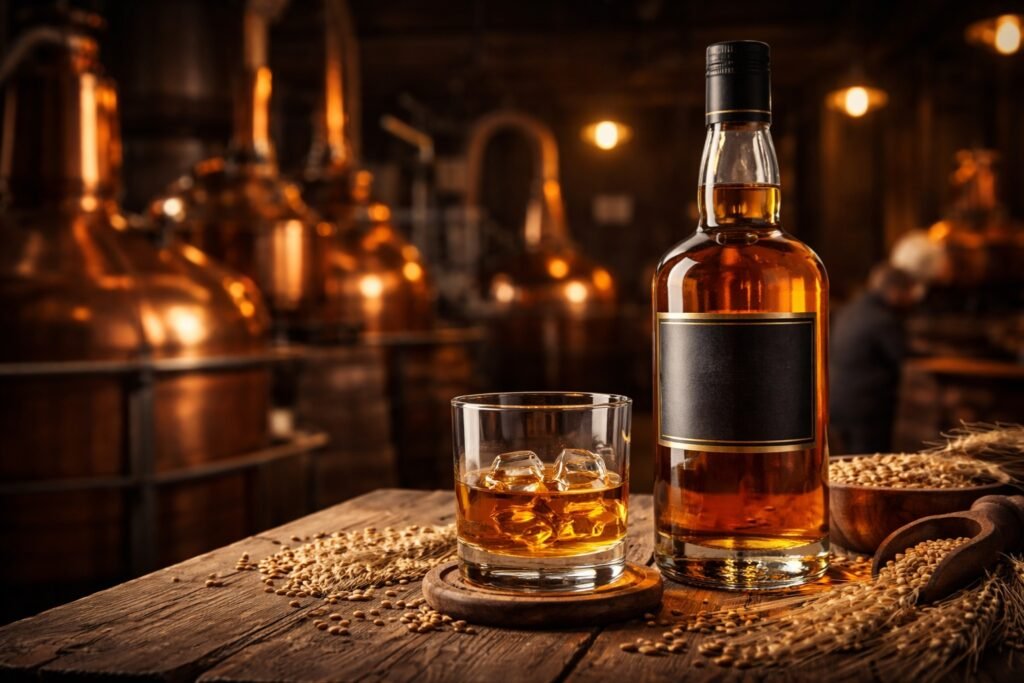
Scotch malt whisky is distilled in copper pot stills. These traditional vessels allow precise control over flavor development. The shape and size of the still directly impact the spirit’s character. Taller stills produce lighter, more delicate whiskies. Shorter, wider stills create heavier, richer spirits.
Most single malts are distilled twice. The first distillation produces a low-alcohol liquid called “low wines.” The second distillation concentrates the alcohol and refines the flavors. Some distilleries, particularly in the Lowlands, distill three times for an even smoother result.
Grain whisky uses continuous column stills, which produce a lighter, more neutral spirit at higher volumes. This efficiency makes grain whisky the backbone of blended Scotch.
This is where Scotch transforms. The spirit enters oak casks as a clear, harsh liquid and emerges years later with color, complexity, and smoothness. The wood breathes, allowing the whisky to interact with air, extract flavors from the barrel, and mellow over time.
Most casks are previously used barrels from bourbon, sherry, or wine production. Bourbon barrels impart vanilla, caramel, and sweet oak notes. Sherry casks contribute dried fruit, spice, and richness. Wine casks add subtle fruit and floral characteristics.
Scottish law requires a minimum of three years, but this barely scratches the surface. The longer Scotch matures, the more flavor it absorbs from the wood. Climate matters too. Scotland’s cool, damp environment slows maturation, creating gradual, nuanced development. About 2% of the whisky evaporates each year, a loss distillers call the “angel’s share.”
The regulations define five official categories. Each serves a different purpose and offers distinct characteristics.
Single Malt Scotch Whisky is made from 100% malted barley at a single distillery using pot stills. This is the category that showcases a distillery’s unique character. Every decision from water source to still shape to cask selection becomes part of the final flavor. Single malts range from light and floral to heavy and peated.
Single Grain Scotch Whisky comes from one distillery but can include grains beyond malted barley. It’s typically lighter and smoother than single malt, often overlooked but capable of surprising complexity, especially with age.
Blended Malt Scotch Whisky combines single malts from two or more distilleries. No grain whisky enters the blend. Master blenders use this format to create flavor profiles impossible from a single distillery, harmonizing different regional characters into something greater than the sum of its parts.
Blended Grain Scotch Whisky mixes single grain whiskies from multiple distilleries. It’s the rarest category, offering a lighter, approachable style with creamy sweetness and gentle spice.
Blended Scotch Whisky is the most common type, accounting for roughly 90% of global Scotch sales. It combines single malt and single grain whiskies from different distilleries. Blending ensures consistency across bottlings and creates smooth, balanced whiskies that work well in cocktails or served neat. Brands like Johnnie Walker, Chivas Regal, and Dewar’s fall into this category.
Scotland’s geography creates five traditional whisky regions. Each has a distinct flavor profile shaped by local climate, water sources, and production traditions.
Speyside sits in northeastern Scotland along the River Spey. It’s home to the highest concentration of distilleries in the country. Speyside whiskies are typically elegant, fruity, and sweet, with notes of apple, pear, honey, and vanilla. Minimal peat influence. Think Glenfiddich, Glenlivet, and Macallan.
Highlands is the largest region, covering most of northern Scotland. The diversity here is enormous. Highland whiskies range from light and floral to rich and full-bodied, with some offering heather, honey, and nutty characteristics. Glenmorangie and Dalmore represent the spectrum well.
Islay is a small island off Scotland’s west coast with eight active distilleries. This is peat country. Islay malts are smoky, peaty, and maritime, with flavors of seaweed, brine, iodine, and campfire smoke. Laphroaig, Ardbeg, and Lagavulin define the style, though some Islay distilleries produce unpeated expressions too.
Lowlands produces lighter, gentler whiskies. Expect floral, grassy, and citrus notes with minimal complexity. Lowland malts are often triple-distilled for extra smoothness, making them approachable entry points for new drinkers. Auchentoshan is the most recognized name here.
Campbeltown is a tiny peninsula on Scotland’s southwest coast. Once a whisky powerhouse with over 30 distilleries, only three remain: Springbank, Glen Scotia, and Glengyle. Campbeltown whiskies are full-bodied with maritime influence, often balancing peat, salt, and fruit in complex, robust profiles.
These regional characteristics are guidelines, not absolutes. Modern distillers experiment across traditional boundaries, and you’ll find heavily peated whiskies from the Highlands or light, delicate expressions from Islay.
Scotch sits within a larger family of whiskies, each defined by geography and production rules.
Irish Whiskey (note the “e”) is typically triple-distilled, creating a smoother, lighter spirit. Irish distillers use little to no peat, resulting in whiskies with honey, vanilla, and gentle grain character. The production rules are less strict than Scotch, allowing more flexibility.
Bourbon must be made in the United States from a mash containing at least 51% corn. It’s aged in new charred oak barrels, never previously used casks like Scotch. This creates bold vanilla, caramel, and sweet oak flavors. Bourbon tends toward sweetness and spice compared to Scotch’s complexity and smoke.
Japanese Whisky emerged in the 1920s, modeled directly on Scotch production methods. Japanese distillers studied in Scotland and brought those techniques home. The process is nearly identical, but Japan has no legal minimum aging requirement. Many Japanese whiskies incorporate Scotch malt in their blends.
The key distinction is that Scotch must come from Scotland, follow strict ingredient guidelines, and mature for at least three years in oak. No other whisky carries that specific combination of requirements and regional character.
Scotch is always spelled whisky, without an “e.” This reflects the Gaelic origin of the word, “uisge beatha,” meaning water of life. Ireland and America use “whiskey” with an “e,” a spelling variation that emerged over centuries of linguistic drift. If you see “Scotch whiskey” with an “e,” it’s wrong.
The spelling signals origin and tradition. It’s a small detail that matters to people who take Scotch seriously.
Scotch whisky is more than a set of rules and regional boundaries. It’s a living tradition, shaped by geography, protected by law, and refined by generations of distillers who understand that time, technique, and terroir create something impossible to replicate anywhere else in the world.